



What’s Scrub Daddy Net Worth? Insights into His Wealth
 Jillian Hunt
March 3, 2026 5:29 pm
.
14 min read

What does “scrub daddy net worth” really mean — the brand value, the company valuation, or the founder’s personal wealth?
Readers often see big headlines claiming lifetime sales and huge valuations. Scrub Daddy appeared on Shark Tank in 2012 and later reported massive sales milestones. Those numbers shape public ideas about value.
The business is private, so any figure is an estimate. Expect mentions of lifetime sales (reported at $670M+ and sometimes cited higher), revenue estimates (about $220M in 2023 and an estimated $340M in 2024), and valuations often near $500M.
This article will link the product story — why the sponge works — to the business story — how the company scaled. It will explain valuation versus revenue versus sales, and note ownership stakes like Lori Greiner’s 20% and the founder’s majority share.
Expect a simple, practical breakdown that shows why different outlets publish different numbers without being wrong.
Scrub Daddy at a Glance: The Smiley-Faced Sponge That Sparked a Cleaning Brand
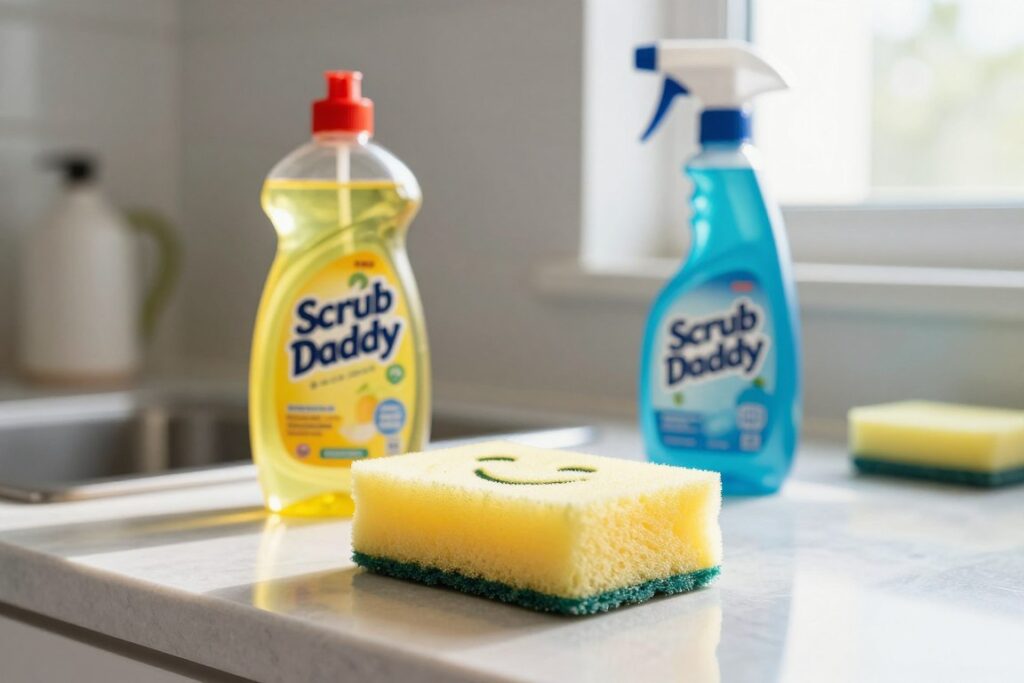
A simple, smile-faced scrub tool married clever materials science with everyday needs. The product stands out not for flash, but for a practical twist: it changes with water temperature to match the task.
Temperature-responsive design
The material gets firmer in cold water, which helps tackle stuck-on messes. Warm water softens the pad for gentle wiping and polishing.
Why the face matters
The cutout “eyes” act as finger grips for control. The “mouth” fits around utensils and tight spots, turning a single item into a mini tool set.
From one product to a product line
What began as one clever sponge became a broader range of cleaning products. The brand now includes a reported ~160 items, showing that lasting value comes from a full catalog, not just a hero item.
For a quick overview of the business side behind the design, see this concise profile at the company snapshot.
How Shark Tank Changed Everything for Scrub Daddy
A single TV appearance turned a simple cleaning idea into a national retail story. The founder walked into the show with clear early traction and a focused plan to scale manufacturing and broaden retail reach.

Season 4 pitch recap: the ask and the proof
Aaron Krause asked for $100,000 for 10% after reporting $100,000 in four months on QVC. That QVC figure served as proof of demand and helped justify plans to take over manufacturing and supply brick-and-mortar stores.
The bidding war and the hero-product logic
Multiple investors saw a mass-market opportunity. The product’s simple demo made it easy to imagine broad retail success.
- The Sharks competed because the item was demonstrable and relatable.
- Lori Greiner positioned it as a “hero” product and offered $200,000 for 20%.
- Her deal gave the company distribution muscle and on-air credibility.
Cause and effect: the show delivered distribution, credibility, and momentum. That equity stake and subsequent growth are the starting point for later headlines about company valuation and founder success.
scrub daddy net worth: What It Means and What Numbers Actually Tell Us

Public totals mix up cumulative sales, annual revenue, and what investors call valuation. Those three figures answer different questions. Clear labels help readers know what each number really represents.
Company valuation vs. lifetime sales vs. annual revenue
Lifetime sales means cumulative sales since launch — often reported at $670M+ and sometimes higher. Annual revenue shows yearly income (examples: ~$220M in 2023, ~$340M estimated in 2024). Valuation is a market estimate of what the company could sell for today, often cited near $500M.
Brand value vs. the founder’s personal net worth
Brand value reflects recognition, shelf space, and IP. The founder’s personal net worth depends on equity share, liquidity, and other assets. They are related but not the same.
Why private-company estimates vary across sources
Estimates differ because private firms disclose little public data. Outlets use different profit margins, multiples, and dated figures. Check the date and the metric cited before accepting any headline.
- Quick takeaway: Look for the metric (sales, revenue, or valuation) and the date.
- For a concise financial profile, see a company snapshot at this profile.
Scrub Daddy’s Sales, Revenue, and Valuation in the Present Day
Current public figures mix rolling sales totals with fresh revenue snapshots, so numbers need careful context.
Lifetime sales milestones most often cited include a company total of about $670M+ since 2012 and other reports that top $800M+. Both can be correct: different cut-off dates and reporting methods explain the gap.
The recent annual performance shows clear momentum. Reported revenue was roughly $220M in 2023 and is estimated at about $340M for 2024. Those figures signal continued retail success and recurring purchases across a broad product line.
Also Read:
Valuation snapshots and why ranges differ
Market estimates often center near a $500M valuation. That number usually reflects multiples of current revenue and growth expectations rather than cumulative sales.
Lower ranges (for example, $250M–$350M) show up when analysts use conservative multiples, older data, or tighter assumptions about profitability and margins.
How revenue multiples shape headlines
Valuation is commonly expressed as a multiple of annual revenue. For example, a 1.5x–2x revenue multiple applied to $340M would create very different headlines than a 1x multiple on $220M.
- Lifetime sales vs. annual revenue: lifetime totals illustrate scale; annual revenue drives market value.
- Why repeat purchases matter: recurring product buys and about 160 SKUs support steady revenue.
- Watch events: a sale or funding round can instantly reset what the company is considered to be worth.
Who Owns Scrub Daddy? Aaron Krause, Lori Greiner, and the Stake Breakdown
Equity splits tell the clearest story about who benefits if the company is sold or goes public. Knowing precise percentages makes it easier to translate valuation headlines into likely payouts.

Lori Greiner’s deal: $200,000 for a 20% stake
Lori Greiner invested $200,000 for a 20% stake after the on‑air negotiation on the show. That 20% became meaningful as sales soared, turning a modest investment into a large paper value.
Does Lori still own her stake?
Recent reporting indicates there are no public records of her selling that stake. For a closer look at reported payouts and timelines, see this Lori Greiner payout analysis.
Aaron Krause as majority owner and CEO
Aaron Krause remains the majority owner and serves as CEO. Majority ownership is the main driver of his personal value because it controls how proceeds are split in any sale.
What a potential sale could mean for investors
Advisors like JPMorgan have been reported to explore strategic options. If the company were priced near $500M, a 20% stake is often cited as roughly $100 million on paper. Actual cash to investors depends on deal terms, dilution, and approvals.
Bottom line: public deal talk helps set expectations, but private cap tables and liquidity rules determine who actually walks away with cash.
For a concise company snapshot, check this company profile.
Aaron Krause Net Worth: How the Founder’s Wealth Is Estimated
Estimating a founder’s personal wealth mixes public signals with private facts, and those signals often change fast.

Analysts build an estimate by multiplying an assumed company valuation by the founder’s equity share, then adjusting for liquidity and known debts or payouts.
Commonly cited ranges for Aaron Krause land between roughly $70M and $100M. That range reflects published valuation scenarios and reported ownership stakes.
Founder estimates differ from company value because company valuation is not the same as cash in hand. Equity can be illiquid, tied to earn-outs, or diluted after rounds.
Also Read:
What can change the estimate fast
- A new valuation benchmark or an acquisition offer.
- A partial sale or dividend that converts paper value to cash.
- Income from other ventures — Krause sold an earlier car wash/buffing pad business to 3M, which also adds to his profile.
Media updates tend to cluster after big revenue years or acquisition rumors, so reader caution is wise when interpreting any single reported figure.
Why Scrub Daddy Became a Retail Powerhouse
Wide retail distribution turned a simple cleaning tool into a household name almost overnight.
The company reached roughly 257,000 retail locations worldwide, which fuels repeat purchases and steady brand recognition.

Retail reach and visibility
Being in big-box stores, grocery chains, and specialty shops means more chances to be seen and bought.
That kind of shelf presence supports larger revenue expectations for the company.
Expanding the product line
Today the catalog includes about 160 products beyond the original item.
More SKUs increase shelf space, bring variety to shoppers, and help win different cleaning jobs.
Scaling through channels and demos
Early QVC exposure gave rapid proof of demand and showed the tool in action for millions of viewers.
Televised demos and Shark Tank attention made the brand easy to explain and buy.
Operational moves that mattered
Manufacturing shifted from Germany to facilities in Chattanooga, Tennessee, and Pennsauken, New Jersey.
That change improved production control, cut lead times, and helped supply major retail partners.
- Mass-market appeal: affordable, demonstrable, and practical — traits that drive long-term success.
- Distribution power: broad retail reach multiplies repeat buys and brand loyalty.
- Operational execution: near-shore manufacturing supports inventory and revenue growth.
Combined, wide availability, a growing range of products, and smart operations helped turn a demoable cleaning tool into a durable retail success. For further context on financial profiles, see a related company snapshot at this profile.
Scrub Daddy as a Shark Tank Success Story Compared to Other Winners
In the Shark Tank universe, a handful of businesses rose from an on‑air pitch to true retail dominance.
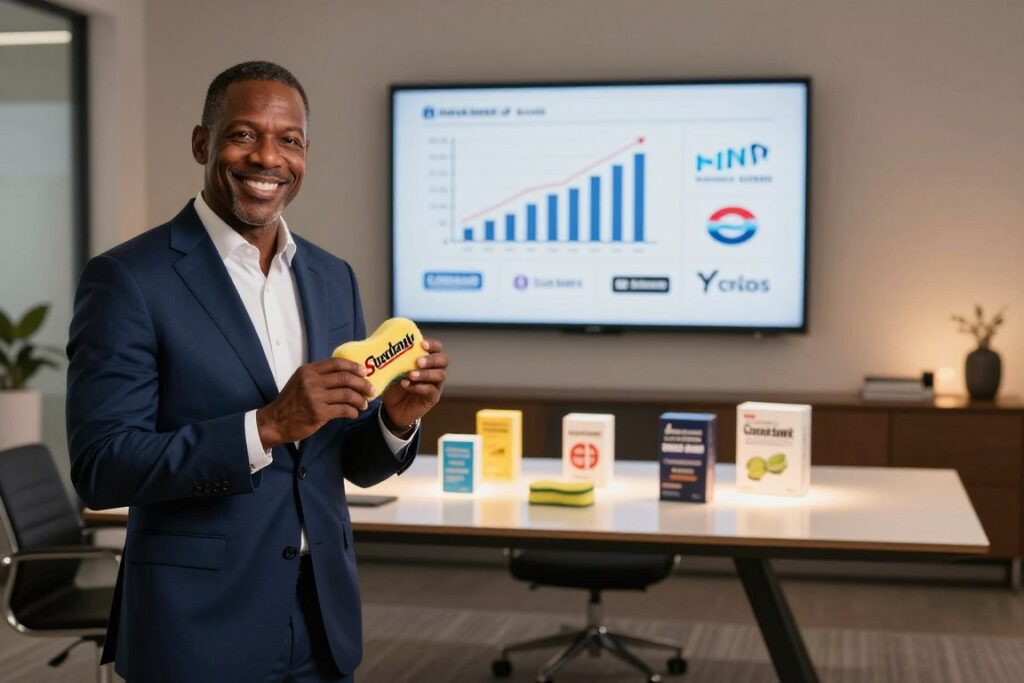
Where it ranks: the company is commonly listed among the top performers from the show. One source places it third, behind Bombas and Everlywell by lifetime sales totals.
Why “success” looks different by metric
Success can mean lifetime sales, annual revenue, valuation, profitability, or exit price. Rankings shift depending on which metric a reporter uses.
Quick benchmarks
- Bombas: ~ $1.3B lifetime sales.
- Everlywell: ~ $1.1B lifetime sales.
- The featured brand: commonly cited at $670M+ since 2012, with some reports at $800M+ or higher.
The takeaway: this is clearly top‑tier among show alumni, but lifetime sales alone don’t define an owner’s payout or a company valuation.
Investment logic: a modest early investment on the show can grow into a nine‑figure headline if the company scales and attracts high revenue multiples. For private companies, the biggest next inflection is often a sale.
What to Watch Next for Scrub Daddy’s Wealth Story
What to watch next for Scrub Daddy’s wealth story
The most likely paths are a formal sale process, a partial recapitalization, or steady private growth tied to retail expansion.
Readers should track credible valuation updates, confirmed acquisition talks, and any major retail or partnership announcements. Operational moves — leadership focus, manufacturing shifts, and fresh cleaning products — often precede big transactions.
Revenue momentum matters: reported revenue near $220M in 2023 and an estimated $340M in 2024 makes valuation sensitive to growth multiples. Ownership matters too — Aaron Krause as CEO and majority owner and Lori Greiner as a minority investor would see different outcomes depending on deal structure.
Keep it practical: separate lifetime sales bragging from true company valuation, and watch dated, source-backed numbers. As long as the sponge and broader line stay useful and easy to find at retail, the brand has room to grow.
FAQ
What’s Scrub Daddy Net Worth? Insights into His Wealth
Estimates for Aaron Krause’s personal wealth vary because the company is private. Financial commentators commonly place his net worth between roughly million and 0 million, based on lifetime sales, ownership stake, and recent valuation estimates for the business. These figures change with revenue reports, licensing deals, and any potential liquidity events like a partial sale or investment round.
What is the product and why did it spark a cleaning brand?
The smiley-faced sponge launched a larger company by solving an everyday problem: it changes texture with water temperature — firm in cold water for tougher scrubbing and softer in warm water for gentle cleaning. The face design adds grip, lets users clean utensils and tight spaces more easily, and creates a memorable visual identity that helped the product go viral in retail and on TV.
How did the product perform on Shark Tank and what happened in Season 4?
In Season 4, inventor Aaron Krause pitched the sponge and asked for investment to scale production and distribution. Lori Greiner invested 0,000 for a 20% stake. The deal and the appliance-focused appeal created national exposure that accelerated sales and retail placement, turning the item into a breakout category leader.
Company valuation vs. lifetime sales vs. annual revenue — what’s the difference?
Lifetime sales measure total cash received from product sales since launch; annual revenue is sales in a single fiscal year. Valuation estimates the company’s market worth, typically using revenue multiples, profitability, and growth prospects. Media headlines sometimes conflate these terms, so it’s important to distinguish the metrics when assessing business size or the founder’s wealth.
Why do private-company estimates for value and personal wealth vary across sources?
Private firms aren’t required to publish audited financials, so analysts rely on press releases, interviews, distributor data, and retail sell-through figures. Different assumptions about margins, ownership dilution, and revenue multiples lead to divergent estimates. Timing of reports also matters when the business experiences rapid growth.
What are the most-cited sales and revenue figures for the company today?
Publicly cited milestones include lifetime sales reported above 0 million since about 2012, with some outlets citing totals exceeding 0 million. Recent annual performance numbers reported in business press show around 0 million in 2023 and projections near 0 million for 2024. These figures reflect expanded product lines and broader retail distribution.
How do valuation snapshots reach figures near 0 million?
Valuation estimates around 0 million come from applying revenue multiples common in consumer packaged goods to the company’s recent annual revenue, while factoring brand strength and retail reach. Some outlets use more conservative multiples or adjust for profitability, producing lower ranges.
What was Lori Greiner’s Shark Tank deal and does she still own a stake?
Lori Greiner invested 0,000 for a 20% stake on Shark Tank. Over time, reporting has shown changes in ownership stakes for many companies due to buybacks or additional financing. Recent public coverage suggests Aaron Krause remains the majority owner and CEO, though specific current percentages can vary and are not always publicly disclosed.
How does Aaron Krause’s ownership affect his estimated wealth?
Krause’s personal net worth depends largely on his ownership percentage, company valuation, and any dividends or salary he receives. A majority stake in a high-grossing private company supports higher net worth estimates, but until a liquidity event (sale, IPO, or large secondary sale) occurs, exact figures remain estimates.
What could move the founder’s net worth significantly?
Major drivers include a formal sale of the company, a public offering, strategic minority investments, or sustained revenue growth that raises valuation multiples. Licensing deals, international expansion, or successful new product categories can also boost company value and the founder’s wealth.
How extensive is the brand’s retail reach and product lineup?
The business grew into a retail powerhouse, reported in many sources to be present in roughly 257,000 retail locations globally. The product family expanded to around 160 SKUs beyond the original sponge, including specialty cleaning tools and accessories that leverage the brand’s problem-solving positioning.
What marketing and operational moves helped scale the brand?
Key growth levers included Lori Greiner’s QVC exposure, national retail placement in mass-market stores, strong direct-to-consumer channels, and a clear product story. Operationally, shifting manufacturing to U.S. facilities in Tennessee and New Jersey helped control quality and supply chains, supporting retailer requirements and larger orders.
Where does this success rank among other Shark Tank winners?
The company often ranks among the top Shark Tank successes by lifetime sales and brand recognition. Comparisons to brands like Bombas show different trajectories — some firms grow via apparel or subscription models while others scale through mass retail — so “success” depends on metrics like revenue, profitability, and founder outcomes.
What should observers watch next in the company’s wealth story?
Watch for any announcements about new funding rounds, partial or full sale, an IPO, or larger international distribution deals. Changes in annual revenue and reported valuation multiples will directly influence future estimates of both company value and the founder’s personal net worth.
Hey there! I'm Jillian Hunt. I'm all about diving into the financial side of celebrities' lives and sharing those juicy details with you. I love turning complicated money stuff into fun and easy reads. Whether it's checking out how a newbie is making waves or seeing what the big names are doing with their cash, I'm here to give you the scoop in a way that's both interesting and easy to understand.