



Quincy Jones Net Worth: How Rich is He?
 Jillian Hunt
December 17, 2025 5:58 pm
.
11 min read
Jillian Hunt
December 17, 2025 5:58 pm
.
11 min read

He left an unmatched legacy in American music and entertainment. At his death on November 3, 2024, he had about $500 million in assets, a sum that reflects decades of genre‑bridging work as a producer and arranger. His catalog and royalties powered by blockbuster albums and film scores help explain that headline figure.
Across more than six decades he earned 28 Grammy Awards and produced era‑defining records like Off the Wall, Thriller and Bad, which sold over 150 million copies combined. His career also included film scores, TV projects and early executive breakthroughs that turned creative success into sustained financial value.
The biography, early years in Seattle jazz, study at Berklee, and a mother who shaped his resilience are part of the story behind the money. For a detailed breakdown of how that $500 million figure was tallied, see this concise profile on his net worth and legacy.
Net Worth at a Glance: The $500 Million Legacy
By the time he died in 2024, public estimates placed his estate near 500 million dollars. That headline figure bundles decades of earnings from record production royalties, publishing and licensing tied to iconic recordings, plus film and TV scoring and television production credits.
His role as a producer turned major credits into recurring income through points, upfront fees, and backend participation. Music catalogs and licensing deals kept revenue flowing long after initial release cycles.
- Royalties and publishing formed the core of the estimate.
- TV and film projects broadened revenue beyond records.
- Real estate in prime Bel Air added measurable asset value over time.
The quick snapshot shows how durable demand for his work supported steady cash flow across decades. While figures vary by source, multiple reputable reports converge on a similar net worth range, lending confidence to this overview.
How Quincy Jones Built His Fortune
From jazz clubs to global stages, he learned how musical craft turns into lasting revenue. He began as a trumpeter and arranger in Seattle, working with Sarah Vaughan and ray charles, then rose to become Mercury’s first African American executive in 1961.
Record Producer at the Pinnacle: From Jazz Roots to Global Pop
He translated bandstand instincts into precise studio work. That skill let him guide artists and assemble top talent for studio sessions.
The result: acclaimed records and a producer premium that increased his share of album earnings.
Royalties and the Michael Jackson Era: Off the Wall, Thriller, and Bad
His strategic collaboration with michael jackson produced Off the Wall, Thriller, and Bad, selling over 150 million albums combined.
Points and backend participation on those releases created durable royalties every time a track was sold, streamed, or licensed.
Film and TV Credits: From The Color Purple to The Fresh Prince of Bel-Air
He scored films like The Italian Job and the score for The Getaway, and he produced TV projects including fresh prince bel-air and The Color Purple adaptation.
Those film and show placements refreshed demand for his catalog and diversified income across decades.
- Producer instincts that bridged jazz and pop.
- High-profile partnerships and charity projects that widened his influence.
- Catalog depth that turned artistic hits into long-term revenue.
Bel Air to Beverly Hills: Real Estate and High-Value Assets
Architectural statement properties anchored a portfolio that blended lifestyle with long-term value.

The signature home bel air compound spanned about 25,000 square feet on 2.3 acres. Designed by Gerald “Jerry” Allison with WATG and inspired by The Palace of the Lost City, the estate featured a domed living room and a professional recording studio.
Other amenities included a wine cellar, screening room, guest suites, an infinity-edge pool and a tennis court. The property showcased how a creator could merge music operations with private, high-end living.
The Bel Air Mansion: Design, Features, and the $59.995M Listing
After buying a Bel Air home in 1986 for $3 million and selling one holding in 2005 for $5.4 million, he built the larger custom estate. That compound was listed in May 2025 for $59.995 million, underlining blue-chip Los Angeles pricing.
Other Homes and Holdings: Holmby Hills/Beverly Hills Footprint
Reports list additional mansions in Holmby Hills and prime Beverly Hills neighborhoods, which diversified his home footprint and preserved value in stable enclaves.
Luxury Cars and Collectibles: Rolls-Royce, Aston Martin, Mercedes-Benz
The tangible collection rounded out assets. Notable vehicles reportedly included a Rolls-Royce Ghost (~$350k), an Aston Martin Vantage (~$190k), and a Mercedes‑Benz E350 (~$75k).
- Real estate strategy: prime bel air acreage with lasting appeal.
- Design pedigree: resort-inspired architecture that boosts resale demand.
- Lifestyle + investment: homes served as private studios and networking hubs for film and music collaborators.
For a different celebrity property perspective, see this short Lindsay Lohan profile for comparison on how high-profile homes factor into a creator’s asset base.
Career Highlights That Powered His Wealth
Key early collaborations and blockbuster albums built the foundation for a multi-decade revenue engine.
Also Read:
Early Breakthroughs: Ray Charles, Frank Sinatra, and Industry Firsts
He arranged for ray charles and worked closely with frank sinatra, wins that validated his ear and leadership.
Becoming Mercury’s first African American executive in 1961 expanded his influence. That role opened access to bigger budgets, top artists, and more decision power over time.
Early studio work and arranging credits positioned him as a go-to producer and arranger for high-profile sessions.
The MJ Trilogy’s Global Impact: Sales Milestones and Producer Prestige
His partnership with michael jackson yielded three landmark albums: Off the Wall (20M+), Thriller (≈70M), and Bad (35M+).
Those records redefined pop production, produced massive album sales and long-tail royalties through reissues and new formats.
- Major singles and album cycles created recurring income over the years.
- Awards and prestige—28 Grammys—boosted negotiating leverage for later projects.
- TV and film work, plus shows like fresh prince bel-air and projects such as The Color Purple, diversified revenue streams.
From assembling musicians to executive appearances, his consistent work turned artistic hits into lasting financial value.
Personal Life and Family
Personal relationships and parenting shaped how he balanced a global music career with home responsibilities.
Married Three Times: Jeri Caldwell, Ulla Andersson, Peggy Lipton
He quincy jones married Jeri Caldwell in 1957, then Ulla Andersson in 1967, and later Peggy Lipton in 1974. These marriages marked distinct chapters while he toured and produced.
Children and Notable Names: Rashida Jones, Kidada, QD3, and More
He fathered seven children, including Quincy Jones III (QD3), Kidada Jones, and Rashida Jones. Other children include Jolie Jones Levine, Rachel Jones, Martina Jones, and Kenya Jones.
Family ties often intersected with work. He redesigned parts of his home to keep studios separate from family space. Ex‑spouses and siblings remained part of a broad support network.
- Survival and change: He recovered from a 1974 brain aneurysm and left risky habits behind early in life.
- Roots: His mother and a close brother influenced his empathy and drive.
- Legacy: The family produced creators across film, fashion, and production—showing how private life fed public work.
Readers seeking a fuller family profile can read a related family profile that explores how personal life shaped public achievements.
Royalties, Lawsuits, and Business Deals
As new formats emerged, disputes over posthumous uses of recordings forced hard choices about rights and royalties.

He moved from studio rooms into courtrooms and boardrooms to protect income streams. Clear contract language became essential as film, live productions, and digital uses multiplied.
Posthumous Projects and the Jackson Estate Dispute
In 2013 he sued the michael jackson estate over royalties tied to posthumous projects, including Cirque du Soleil shows and the This Is It film. A jury first awarded $9.4 million, but a 2020 appeals ruling narrowed claims and upheld $2.6 million for unpaid license fees.
Also Read:
Reports say he earned nearly $18 million in Jackson royalties since 2009, showing how legacy catalogs keep generating income long after initial release.
Qwest Productions and the Time Warner Partnership
He founded Qwest Productions and merged with Time Warner in 1990, expanding into television and film production. That move turned him into a tv and media producer with hits that offered repeat revenue through syndication.
- Shows: The Fresh Prince of Bel-Air, The Jenny Jones Show, MADtv.
- Business lesson: Define post-release rights clearly in every collaboration.
- Legacy strategy: Catalog management can stabilize income across cycles.
For a concise profile of estate and asset handling, see this profile that outlines similar celebrity deals. These disputes show that careful business work matters as much as creative vision.
quincy jones net worth Over Time
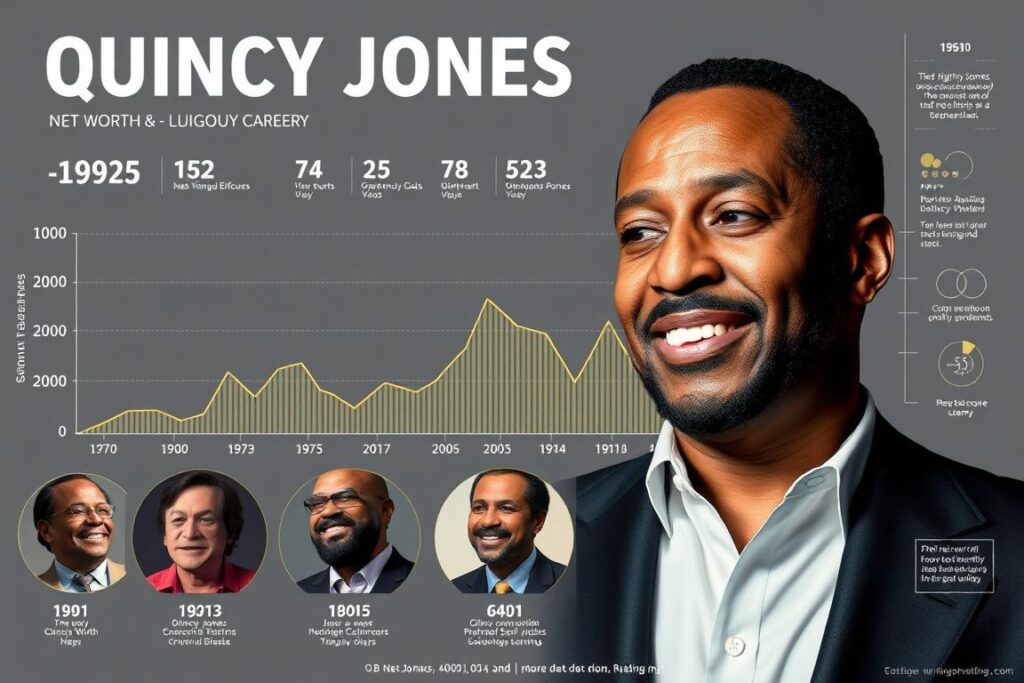
A career that began with touring gigs and arranging charts evolved into a diversified revenue engine over decades. Early session fees and arranging credits laid a steady financial base. That groundwork led to producer premiums and higher fees as opportunities grew.
From Touring Musician to 500 Million: Decade-by-Decade Growth
In the 1960s he became Mercury’s first Black executive and moved into film scoring, expanding licensing and recurring royalties. The 1970s and 1980s brought an inflection point: work with michael jackson and blockbuster album sales sharply increased income.
- 1960s: executive role and film scores added stable income.
- 1970s–80s: blockbuster releases created long-term royalties.
- 1990s: Qwest–Time Warner TV deals supplied steady back-end revenue.
- 2000s–2020s: catalog resilience across formats and home bel air appreciation preserved capital.
Viewed across time, the timeline shows deliberate deals, smart project selection, and asset choices that culminated in a durable net worth near 500 million time.
A Lasting Legacy That Transcends the Numbers
, Beyond dollar figures, his legacy lives in songs, film scores, and the artists he mentored.
Quincy Jones shaped American music across decades, working with ray charles and frank sinatra, earning 28 Grammys and helping create moments like “We Are the World.”
As a producer he lifted musicians and filmmakers, turning studio sessions into cultural touchstones. His film contributions tied music to storytelling that audiences still revisit.
Family mattered: seven children and a multigenerational creative clan carry his values forward. In time, the reported net worth is only one way to measure a life whose true value lives in the work and the people he inspired.
FAQ
How rich is Quincy Jones?
Estimates place his fortune around 0 million, built over decades as a top record producer, composer, and media executive. Much of that wealth comes from major album projects, publishing royalties, and strategic business deals.
How did he build his wealth?
He rose from jazz arranging to producing chart-topping pop records, managing publishing rights, producing films and TV shows, and forming partnerships such as Qwest Records. High-profile collaborations and long-term royalties played major roles.
Which albums generated the most income?
The albums he produced for Michael Jackson — including Off the Wall, Thriller, and Bad — delivered massive sales and enduring royalties. Those projects significantly boosted his earnings and industry reputation.
Did film and TV work add to his earnings?
Yes. He produced and scored films like The Color Purple and executive produced TV projects, including The Fresh Prince of Bel-Air, which contributed licensing fees, residuals, and production income.
What notable early collaborations helped his career?
Early work with Ray Charles and arranging for Frank Sinatra opened doors in major labels and studios, establishing him as a sought-after arranger and producer during the rise of modern pop and jazz crossover.
Where are his real estate holdings concentrated?
He has owned high-value properties in Bel Air, Holmby Hills, and Beverly Hills. A Bel Air mansion once listed for about .995 million exemplifies the scale of his residential investments.
Does he collect luxury cars and other valuables?
Over the years he has owned high-end cars and collectibles, including models from Rolls‑Royce, Aston Martin, and Mercedes‑Benz, reflecting his lifestyle and status in the entertainment world.
How many times has he married?
He married three times: Jeri Caldwell, Ulla Andersson, and Peggy Lipton. Each marriage and partnership influenced his personal life and public profile.
Who are some of his notable children?
His family includes prominent names such as Rashida Jones, Kidada Jones, and Quincy Jones III (QD3), many of whom pursued careers in entertainment and media.
Have royalties or lawsuits affected his finances?
Royalties are a steady income source, though he has faced legal disputes related to posthumous projects and the Michael Jackson estate. Business settlements and partnerships have shaped income streams over time.
What is Qwest Productions and how did it matter?
Qwest Productions and Qwest Records were his ventures into label ownership and production. Strategic alliances, including deals with major media companies, expanded his control over distribution and catalog revenue.
How did his net value change over the decades?
He moved from touring and arranging in the 1950s–60s into producing in the 70s–80s, then to executive and entrepreneurial roles. Each phase — live performance, hit records, publishing, and media production — added incremental wealth leading to the half‑billion estimate.
Is his legacy more than financial?
Absolutely. Beyond financial success, his influence shaped modern pop, jazz, and film music. His collaborations and mentorship helped launch careers and changed the industry’s sound and business practices.
Hey there! I'm Jillian Hunt. I'm all about diving into the financial side of celebrities' lives and sharing those juicy details with you. I love turning complicated money stuff into fun and easy reads. Whether it's checking out how a newbie is making waves or seeing what the big names are doing with their cash, I'm here to give you the scoop in a way that's both interesting and easy to understand.