



Aaron Krause Net Worth: Insights into His Wealth
 Jillian Hunt
February 24, 2026 6:15 am
.
15 min read
Jillian Hunt
February 24, 2026 6:15 am
.
15 min read

Can a simple sponge turn a small business into tens of millions? This question captures the surprising path from a garage prototype to national retail shelves.
He is an entrepreneur and inventor best known for Scrub Daddy and a 2012 Shark Tank breakthrough. This profile sets expectations: a clear, practical view of present-day wealth and how public estimates form.
Readers will learn how reported figures arise, what is publicly known, and which factors push the number up or down. Key drivers include company ownership, product sales scale, retail distribution, and brand expansion beyond a single sponge.
The article will compare estimates and explain why ranges exist. It will trace turning points: early manufacturing work, the foam discovery, the Shark Tank moment, and the long-term effects on his financial journey and success.
Aaron Krause’s Net Worth Today and What the Estimates Really Mean
Public estimates diverge because observers must model a private business using imperfect data.
Reported figures in public sources
Two headline numbers appear: one outlet lists $200 million, while others estimate a range of $70 million–$100 million (as of 2024). Both are estimates built from sales chatter, reported valuations, and ownership assumptions.
Why numbers can vary
At its simplest, net worth equals assets minus liabilities. For founders, most value sits in private equity, not cash.
- Different sources pick different company valuations and revenue multiples.
- Ownership share matters: a majority owner will count very differently than a minority investor.
- Private assets like real estate or loans are often hidden, so totals can swing when those are included or omitted.
Scrub Daddy is private, so outside estimates rely on comparable companies, reported sales, and headlines. Later sections will quantify the biggest inputs: ownership stake, company performance, and events (like a sale) that could reprice the business.
Aaron Krause Biography: Early Life, Education, and First Businesses
His early years in Wynnewood set the tone for a hands-on tinkerer who learned by taking things apart.
Born February 1, 1969, he grew up in a household focused on hard work; both parents were physicians and encouraged persistence. That environment helped shape his inventor mindset and practical problem solving.

From Lower Merion to Syracuse
He attended Lower Merion High School and earned a B.S. in psychology from Syracuse University in 1992.
The psychology background gave him an edge in reading buyer behavior, packaging appeal, and shelf psychology—skills useful for consumer products and retail placement.
Auto-detailing and manufacturing roots
He started in auto detailing, then built a manufacturing company for buffing pads and polishing tools.
- Operational discipline: running production and quality control long before Scrub Daddy.
- Material know-how: deep familiarity with foams and manufacturing limits.
- Major milestone: selling the buffing-pad company to 3M in 2008, a credibility and liquidity event that preceded later success.
That blend of practical skill, academic insight, and manufacturing experience set the stage for his later journey as an inventor and founder building products in the United States and beyond. For a concise profile and reported estimates, see this profile on his early career and successes: early career profile.
From Polymer Foam to Scrub Daddy: The Product That Changed Everything
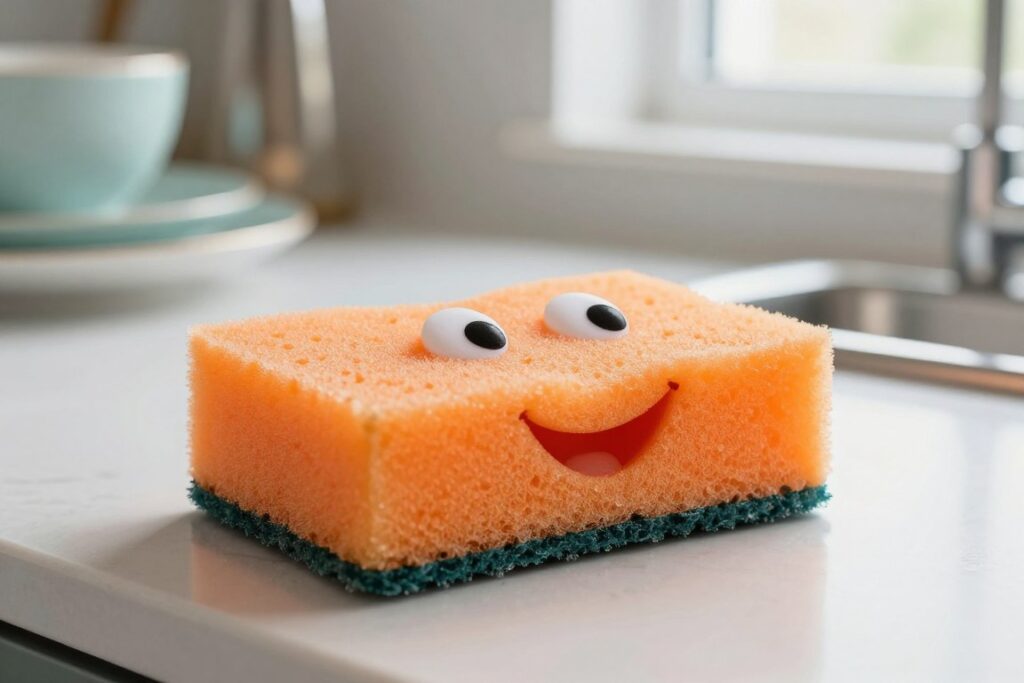
A temperature-reactive foam shifted an inventor’s idea from a shelved prototype to a viral cleaning product. The material, later named FlexTexture, is firm in cold water and softens in warm water.
How FlexTexture was discovered
He found the polymer while running a manufacturing shop. The foam felt different when rinsed. That simple behavior became the core advantage: firm for tough grime, gentle for delicate surfaces.
Why the first hand-scrubber failed
The 2007 hand-scrubber was patented but struggled in stores. Retail buyers saw it as unfamiliar and pricey. Packaging and positioning did not explain the texture benefit clearly.
Design, demos, and early momentum
The 2011 relaunch turned the idea into a kitchen sponge with a smiley face and utensil-cleaning cutouts. The friendly look and sink demos made the product instantly relatable.
- Grip-friendly shape that fits the hand.
- Cutouts that clean silverware and reach curves.
- Simple demo anyone can repeat at the sink.
Local press and QVC appearances proved demand before big-box retail stepped in. That early product-market fit helped scale repeat sales and begin the path to sizable wealth. Read a concise profile for more background: Scrub Daddy profile.
Shark Tank 2012: The Lori Greiner Deal and the Retail Breakthrough
The Shark Tank appearance in 2012 transformed a clever demo into a national retail story.
On air, the standout moment was the “changes texture” demonstration. Viewers could see and grasp the benefit in seconds. That live proof made the product believable and instantly sharable.
Also Read:
Deal terms and ownership
During the show, Lori Greiner offered a $200,000 investment for a 20% stake. That 200,000 stake implied a $1 million company valuation on camera and aligned incentives for rapid growth.
Why the partnership mattered
Greiner’s expertise with QVC and big-box placement turned attention into distribution. The investment was not just capital; it was a retail and media play that accelerated sales.
Immediate results and retail scale
After the episode aired, the product sold out of 42,000 units on QVC in under seven minutes—clear proof of demand.
- Rapid sellouts validated consumer interest.
- National retailers followed: Walmart, Target, Bed Bath & Beyond, and Home Depot added shelves.
- Retail distribution multiplied sales and long-term company value.
For a compact profile that tracks media moments and retail growth, see this related summary: early profile link.
aaron krause net worth drivers: Scrub Daddy revenue, valuation, and ownership stake
The founder’s personal value ties directly to three things: fast revenue growth, a rising company valuation, and how much equity he still owns.
Revenue momentum and what it signals
Scrub Daddy grew from about $66.7M in 2021 to an estimated $340M in 2024. That jump signals strong repeat purchases, successful line extensions, and widening retail reach.
Valuation and how multiples work
An estimated $500M valuation (2024) reflects revenue multiples applied to a fast-growing consumer brand. Multiples rise when margins, growth, and brand strength are strong; they fall if profitability or growth slows.
Ownership, sales milestones, and scale
Lori Greiner’s 20% stake reduces the founder’s share of any sale or liquidation, so majority ownership is key to headline figures.
- Total sales: lifetime sales exceed $800M, showing durability but not equal to profit.
- Retail footprint: available in 257,000+ locations worldwide, which drives volume and pricing power.
- Main wealth engine: founder equity in a high-growth company tied to revenue and valuation assumptions.
Beyond the Sponge: Product Line Expansion, Patents, and Brand Power
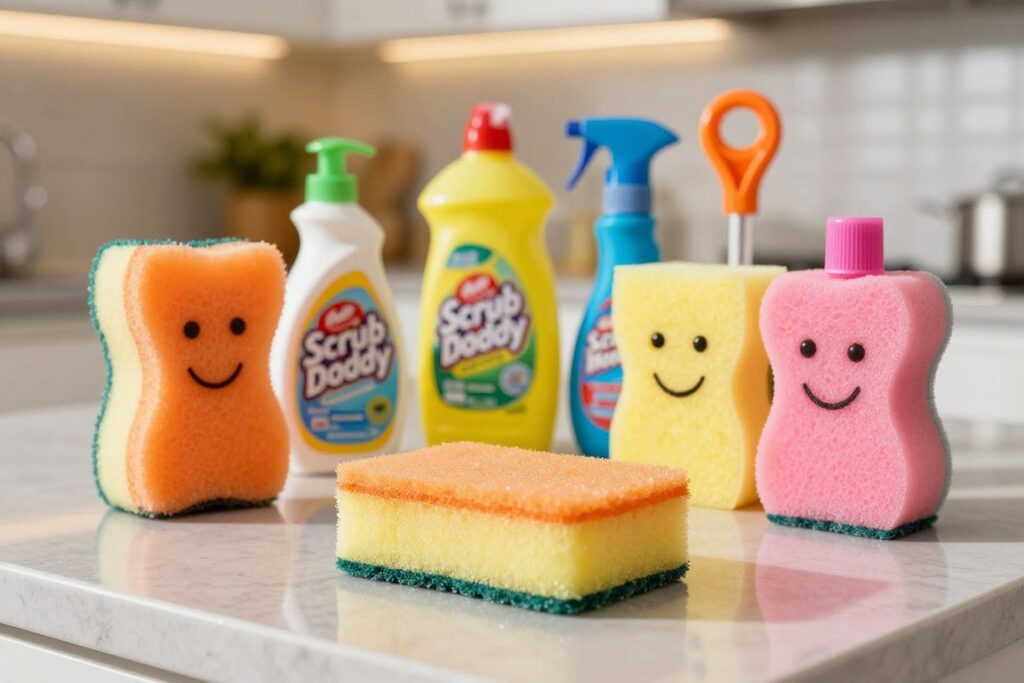
The company expanded quickly from one iconic sponge into a broad family of cleaning items. Today the portfolio includes Scrub Mommy, Scour Daddy, Eraser Daddy, PowerPaste, soap dispensers, and sink organizers. That breadth turns one purchase into many repeat buys.
Growing a product ecosystem
More products mean more shelf space, more online bundles, and higher lifetime value per customer. A larger assortment also helps the brand occupy new aisles and price tiers.
Performance that fuels repeat buying
The FlexTexture foam offers temperature-sensitive texture: firm in cold water and soft in warm. It resists odors, rinses clean, and lasts longer than many sponges. Those claims—durability, odor resistance, and surface-safe cleaning—drive repeat purchases.
Patents and a protective moat
The inventor holds dozens of patents and trademarks that protect design, texture, and branding. This legal layer makes it harder for competitors to copy the experience and helps preserve the company’s market position.
- Memorable look and simple demos aid conversion.
- Wide distribution sustains scale and brand recognition.
- Product depth supports long-term business success.
What Comes Next for Aaron Krause’s Wealth and the Scrub Daddy Company
The most important next-step is whether the company stays private, raises fresh capital, or completes a strategic sale. Each path changes valuation and the founder’s personal liquidity in very different ways.
A sale could convert founder equity into cash fast, but taxes and deal terms (cash versus earnout) shape how much wealth is realized. If the cap table stays stable, increases in valuation directly lift his reported net worth.
Also Read:
Continued retail growth and international expansion will keep pushing brand value, while new product launches reduce reliance on one hero item. That combination makes the Scrub Daddy story one of the most durable Shark Tank successes.
For a concise, related profile, see the detailed profile.
FAQ
What is the reported net worth of Scrub Daddy’s founder today?
Public sources list a wide range of estimates for the founder’s wealth, often driven by the company’s reported sales, valuation chatter, and ownership stake after the Shark Tank deal. These figures can vary because private companies do not disclose full financials.
Why do reported estimates of his wealth differ so much?
Estimates change based on valuation methods, recent revenue multiples, and whether analysts include unrealized value from private equity or only cash proceeds. Changes in retail performance, licensing deals, and investor stakes also shift calculations.
How did his upbringing and education influence the product’s development?
Growing up in Wynnewood, Pennsylvania, and studying psychology at Syracuse University helped shape an inventor’s curiosity about consumer behavior. That background supported smart product testing and market positioning when moving from auto-detailing to manufacturing cleaning products.
How was the temperature-sensitive foam concept discovered?
The core FlexTexture idea came from experimenting with polymer foams in an auto-detailing context. He noticed the material’s different feel in warm versus cold water and saw a practical household application for a sponge that softens with heat and firms up in cold water.
Why did the first hand-scrubber fail before the relaunch as Scrub Daddy?
The early version lacked distinctive branding and retail-ready packaging. Iterations improved design, added a recognizable smiley face, and focused on clear demonstrations of performance — changes that made the product easier for shoppers to understand and retailers to stock.
What role did the smiley-face design play in success?
The smiley face provided immediate shelf appeal and functional benefits — the eyes can be used to hold utensils and create scrub angles. That blend of form and function made the product memorable and easy to demonstrate on TV and in stores.
How did Shark Tank change the company’s trajectory?
The Shark Tank appearance provided national visibility and credibility. An on-air demo showing the material’s changing texture convinced investors and consumers. The subsequent deal with Lori Greiner opened doors to QVC and large retailers, accelerating distribution.
What were the terms of the Shark Tank investment and what did they imply?
The televised deal offered 0,000 for a 20% equity stake from Lori Greiner. That implied a
FAQ
What is the reported net worth of Scrub Daddy’s founder today?
Public sources list a wide range of estimates for the founder’s wealth, often driven by the company’s reported sales, valuation chatter, and ownership stake after the Shark Tank deal. These figures can vary because private companies do not disclose full financials.
Why do reported estimates of his wealth differ so much?
Estimates change based on valuation methods, recent revenue multiples, and whether analysts include unrealized value from private equity or only cash proceeds. Changes in retail performance, licensing deals, and investor stakes also shift calculations.
How did his upbringing and education influence the product’s development?
Growing up in Wynnewood, Pennsylvania, and studying psychology at Syracuse University helped shape an inventor’s curiosity about consumer behavior. That background supported smart product testing and market positioning when moving from auto-detailing to manufacturing cleaning products.
How was the temperature-sensitive foam concept discovered?
The core FlexTexture idea came from experimenting with polymer foams in an auto-detailing context. He noticed the material’s different feel in warm versus cold water and saw a practical household application for a sponge that softens with heat and firms up in cold water.
Why did the first hand-scrubber fail before the relaunch as Scrub Daddy?
The early version lacked distinctive branding and retail-ready packaging. Iterations improved design, added a recognizable smiley face, and focused on clear demonstrations of performance — changes that made the product easier for shoppers to understand and retailers to stock.
What role did the smiley-face design play in success?
The smiley face provided immediate shelf appeal and functional benefits — the eyes can be used to hold utensils and create scrub angles. That blend of form and function made the product memorable and easy to demonstrate on TV and in stores.
How did Shark Tank change the company’s trajectory?
The Shark Tank appearance provided national visibility and credibility. An on-air demo showing the material’s changing texture convinced investors and consumers. The subsequent deal with Lori Greiner opened doors to QVC and large retailers, accelerating distribution.
What were the terms of the Shark Tank investment and what did they imply?
The televised deal offered $200,000 for a 20% equity stake from Lori Greiner. That implied a $1 million company valuation at the time and gave the business a strategic partner with deep retail connections.
How have sales and distribution grown since the TV deal?
Sales climbed quickly after national exposure, with major retail placements and QVC momentum leading to rapid sellouts. Over time the brand expanded into hundreds of thousands of retail doors and international markets, driving significant cumulative revenue.
What are the main drivers of the founder’s current financial picture?
The main drivers include cumulative sales, ongoing revenue growth, brand extensions, licensing deals, and the company’s private-market valuation. Ownership percentage after outside investment determines how much of that value accrues to the founder personally.
How large is the product line beyond the original sponge?
The brand expanded into related cleaning products such as Scrub Mommy, Scour Daddy, and cleaning pastes. These extensions leverage the core material benefits—durability, odor resistance, and surface safety—to encourage repeat purchases.
What role do patents and trademarks play in the business’s value?
Patents, trademarks, and trade dress help protect the unique material and iconic design, creating a competitive moat. These intellectual property assets increase licensing opportunities and help maintain shelf exclusivity with retailers.
Are there public estimates of company valuation and how are they derived?
Media and industry sources have suggested valuations in the hundreds of millions based on revenue multiples, comparable consumer-goods deals, and brand strength. Because the company is private, such estimates remain directional rather than definitive.
How does Lori Greiner’s stake affect the founder’s ownership and future payouts?
Her 20% stake reduces the founder’s percentage ownership but added distribution expertise and access to retail channels. That strategic partnership likely increased total company value, which can offset a smaller ownership share through larger exit proceeds or ongoing dividends.
What milestones indicate the company’s scale and market penetration?
Key milestones include national retail rollouts, cumulative sales figures since the Shark Tank appearance, repeat product launches, and sustained TV and QVC performance. Presence in thousands of stores and international availability signal mature scale.
What might influence the founder’s wealth going forward?
Future wealth will depend on continued revenue growth, successful product innovation and international expansion, potential exits or buyouts, and macro retail trends. Strong brand equity and protected intellectual property will support long-term value.
million company valuation at the time and gave the business a strategic partner with deep retail connections.
How have sales and distribution grown since the TV deal?
Sales climbed quickly after national exposure, with major retail placements and QVC momentum leading to rapid sellouts. Over time the brand expanded into hundreds of thousands of retail doors and international markets, driving significant cumulative revenue.
What are the main drivers of the founder’s current financial picture?
The main drivers include cumulative sales, ongoing revenue growth, brand extensions, licensing deals, and the company’s private-market valuation. Ownership percentage after outside investment determines how much of that value accrues to the founder personally.
How large is the product line beyond the original sponge?
The brand expanded into related cleaning products such as Scrub Mommy, Scour Daddy, and cleaning pastes. These extensions leverage the core material benefits—durability, odor resistance, and surface safety—to encourage repeat purchases.
What role do patents and trademarks play in the business’s value?
Patents, trademarks, and trade dress help protect the unique material and iconic design, creating a competitive moat. These intellectual property assets increase licensing opportunities and help maintain shelf exclusivity with retailers.
Are there public estimates of company valuation and how are they derived?
Media and industry sources have suggested valuations in the hundreds of millions based on revenue multiples, comparable consumer-goods deals, and brand strength. Because the company is private, such estimates remain directional rather than definitive.
How does Lori Greiner’s stake affect the founder’s ownership and future payouts?
Her 20% stake reduces the founder’s percentage ownership but added distribution expertise and access to retail channels. That strategic partnership likely increased total company value, which can offset a smaller ownership share through larger exit proceeds or ongoing dividends.
What milestones indicate the company’s scale and market penetration?
Key milestones include national retail rollouts, cumulative sales figures since the Shark Tank appearance, repeat product launches, and sustained TV and QVC performance. Presence in thousands of stores and international availability signal mature scale.
What might influence the founder’s wealth going forward?
Future wealth will depend on continued revenue growth, successful product innovation and international expansion, potential exits or buyouts, and macro retail trends. Strong brand equity and protected intellectual property will support long-term value.
Hey there! I'm Jillian Hunt. I'm all about diving into the financial side of celebrities' lives and sharing those juicy details with you. I love turning complicated money stuff into fun and easy reads. Whether it's checking out how a newbie is making waves or seeing what the big names are doing with their cash, I'm here to give you the scoop in a way that's both interesting and easy to understand.